For many material testing labs, NABL accreditation is a milestone.
But maintaining NABL compliance?
That's the real challenge.
Because accreditation isn't a one-time achievement.
It's an ongoing commitment to quality, consistency, traceability, and documentation.
Every sample received, every observation recorded, every report issued, and every approval given must follow a defined process.
For small laboratories, this may be manageable.
But as sample volumes increase, maintaining compliance manually becomes increasingly difficult.
This is where a Laboratory Information Management System (LIMS) becomes much more than just software.
It becomes the backbone of a compliant laboratory.
What is a LIMS?
A Laboratory Information Management System (LIMS) is a software platform that helps laboratories manage their entire workflow digitally.
Instead of relying on:
-
Excel sheets
-
Paper registers
-
Manual approvals
-
Physical files
A LIMS centralizes every activity into one secure system.
From sample receipt to report dispatch, every step is recorded, tracked, and controlled.
If you're new to the concept, start here:
👉 What is LIMS in Material Testing Labs? (Complete Guide)
Does NABL mandate the use of LIMS?
No.
NABL does not make LIMS mandatory.
A laboratory can achieve accreditation without implementing a LIMS.
However...
NABL requires laboratories to maintain effective systems for documentation, traceability, record management, data integrity, and quality control.
As laboratories grow, meeting these requirements manually becomes increasingly challenging.
That's why many modern NABL-accredited laboratories adopt LIMS—not because it's compulsory, but because it makes compliance easier, more consistent, and less dependent on manual processes.
Why manual compliance becomes difficult
Many laboratories still manage operations using a combination of:
-
Excel files
-
Physical registers
-
Printed observation sheets
-
Email approvals
-
Shared folders
Initially, this works.
But as the laboratory grows, problems start appearing.
Documents become difficult to locate.
Different versions of reports circulate.
Approvals get delayed.
Staff spend more time searching for records than performing productive work.
Eventually, compliance becomes reactive rather than proactive.
How LIMS Supports NABL Compliance
Let's look at the areas where a LIMS makes the biggest difference.
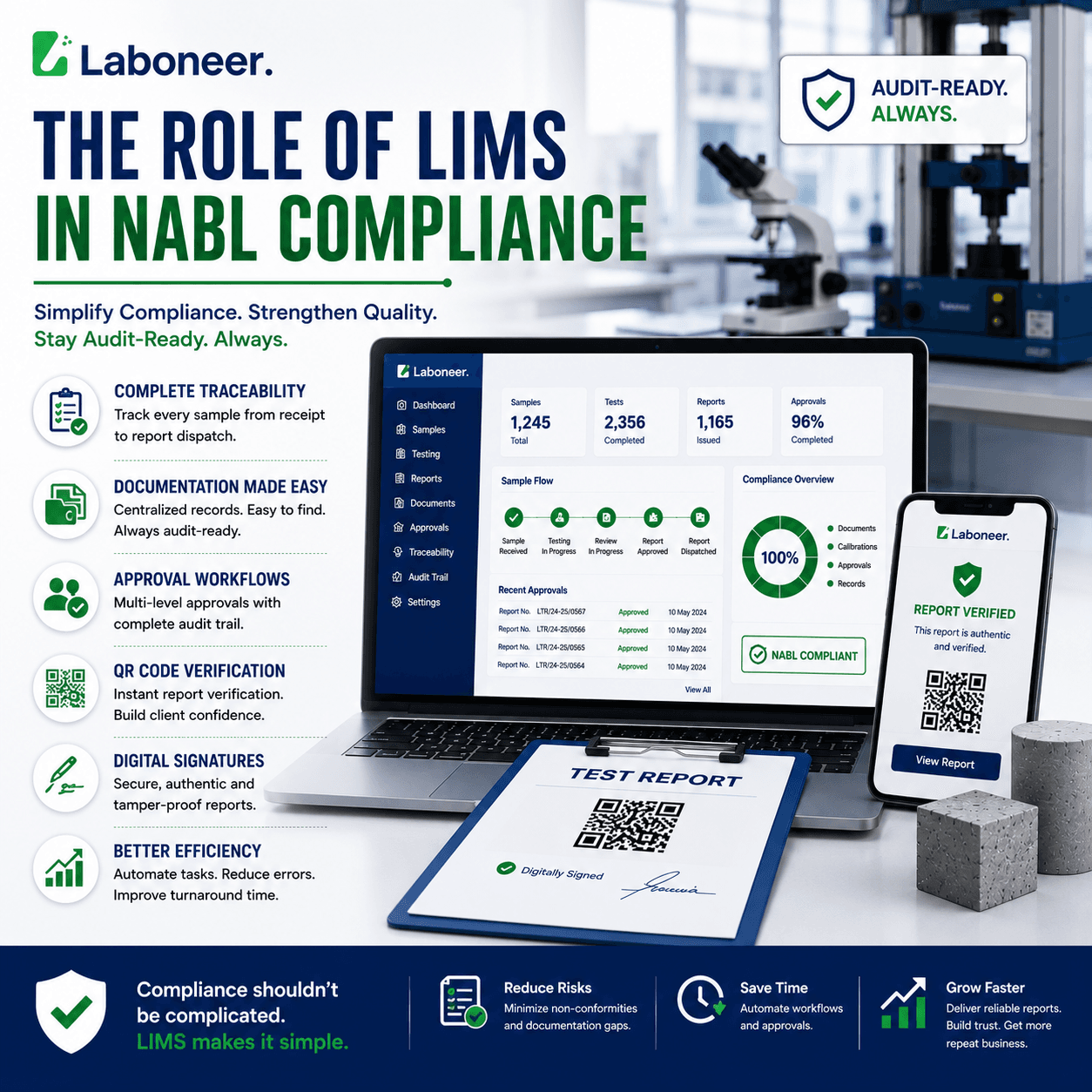
1. Complete Sample Traceability
Every sample has a story.
A compliant laboratory should be able to answer:
-
When was the sample received?
-
Who accepted it?
-
Which tests were assigned?
-
Who performed the testing?
-
When was the report approved?
A LIMS automatically records every stage of the sample lifecycle.
Instead of manually searching through registers, complete sample history is available in seconds.
Related:
👉 Importance of Traceability in Lab Reports
2. Better Documentation Management
Documentation is one of the biggest challenges in NABL-accredited laboratories.
Managing:
-
Observation sheets
-
Calibration records
-
Test reports
-
Approval records
-
Quality documents
Across multiple files and registers often leads to confusion.
A LIMS centralizes documentation, ensuring records remain organized, searchable, and readily available whenever required.
Related:
👉 Documentation Challenges in NABL Labs
3. Standardized Workflows
One common issue in manual systems is inconsistency.
Different team members may follow different processes.
A LIMS standardizes workflows by defining how samples move through the laboratory.
Typical workflow:
Sample Receipt → Inward Approval → Testing → Observation Entry → Technical Review → Report Approval → Dispatch
This reduces dependency on individual working styles and helps maintain consistency across the laboratory.
4. Approval Workflows
Many laboratories still rely on physical signatures or informal approvals.
This often results in:
-
Delayed reports
-
Missed reviews
-
Approval confusion
Modern LIMS platforms include controlled approval workflows where reports move through predefined review stages before release.
This improves both quality and accountability.
5. Audit Trails
One of the biggest advantages of a LIMS is the audit trail.
Every important activity is automatically recorded.
For example:
-
Who created the record?
-
Who modified it?
-
What was changed?
-
When was it changed?
This provides transparency and simplifies investigations whenever questions arise.
6. Controlled Report Generation
Reports represent the final output of the laboratory.
A LIMS helps ensure reports are:
✔ Standardized
✔ Consistent
✔ Approved
✔ Properly documented
Reducing manual report preparation also minimizes the chances of formatting errors and incorrect data entry.
7. QR Code Verification
Clients today expect greater transparency.
By generating reports with QR code verification, laboratories allow clients and project stakeholders to verify report authenticity instantly.
This improves confidence while reducing the risk of report misuse.
Related:
👉 QR Code Verification for Lab Reports
8. Digital Signatures
Manual signatures can create delays and increase the risk of unauthorized use.
Digital signatures help laboratories:
-
Approve reports faster
-
Improve authenticity
-
Strengthen document security
Combined with QR verification, they create a secure and verifiable reporting process.
Related:
👉 Digital Signature in Lab Reports
9. Payment-Based Report Dispatch
This is an operational advantage that also supports business discipline.
Modern LIMS solutions like Laboneer can check whether payment has been received before allowing report dispatch.
This ensures that completed work is not accidentally released without payment, helping laboratories reduce revenue leakage while maintaining controlled report issuance.
10. Improved Operational Efficiency
Compliance shouldn't slow down your laboratory.
It should support efficient operations.
A LIMS helps laboratories reduce:
-
Manual entries
-
Duplicate work
-
Report corrections
-
Follow-up calls
Some material testing reports require entering more than 75–100 observations manually.
With automation, these observations can be updated in seconds, significantly improving turnaround time and reducing human error.
Related:
👉 How to Improve Lab Efficiency and Turnaround Time
Compliance Becomes a Daily Habit
One mistake many laboratories make is preparing for NABL assessments only when the audit is approaching.
This creates unnecessary stress.
With a structured LIMS, documentation, approvals, and records are maintained continuously.
Instead of preparing for audits...
The laboratory remains audit-ready every day.
Beyond Compliance: Business Benefits
Implementing a LIMS isn't only about satisfying auditors.
It also improves business performance.
Laboratories often experience:
✔ Faster report delivery
✔ Better client confidence
✔ Improved repeat business
✔ Reduced operational costs
✔ Better visibility across operations
✔ Higher staff productivity
Compliance and profitability don't have to compete.
The right systems improve both.
Related:
👉 How Automation Improves Lab Profitability
Is LIMS only for large laboratories?
Not at all.
Smaller laboratories often benefit the most because they have limited manpower.
By automating repetitive administrative tasks, they can focus more on testing and client service instead of paperwork.
And as the laboratory grows, the system grows with it.
Ask yourself these questions
-
Can you retrieve any report-related record within two minutes?
-
Can you identify who approved every report?
-
Can clients verify report authenticity instantly?
-
Is every sample fully traceable?
-
Is your laboratory audit-ready every day, not just before assessments?
If these questions are difficult to answer confidently, there may be opportunities to strengthen your compliance processes.
Final Takeaway
NABL compliance is not about collecting more documents.
It's about building confidence.
Confidence that your laboratory follows consistent processes.
Confidence that every report can be trusted.
Confidence that every record can be verified.
A Laboratory Information Management System helps transform compliance from a stressful annual activity into a seamless part of everyday operations.
The result is a laboratory that is not only audit-ready but also more efficient, more professional, and better prepared for sustainable growth.
Want to simplify NABL compliance?
Discover how Laboneer LIMS helps material testing laboratories streamline documentation, automate approvals, strengthen traceability, secure reports with QR verification and digital signatures, and stay audit-ready every day.
Book a free demo today and see how compliance can become simpler—not more complicated.