Let’s start with a simple question.
Can someone edit your lab report today… and get away with it?
If your answer is “maybe” or “not sure”…
You don’t have a reporting system.
You have a risk.
What most labs think
“We generate accurate reports. That’s enough.”
It’s not.
Because the real problem starts after the report leaves your system.
What actually happens in the real world
A contractor:
-
Downloads a genuine report
-
Edits a few values
-
Prints it
-
Submits it
No one checks.
Bill gets cleared.
And when something fails?
👉 Your lab is questioned.
So where does QR Code Verification come in?
QR Code Verification adds one simple but powerful layer:
👉 Anyone can verify your report instantly.
No assumptions.
No blind trust.
Just proof.
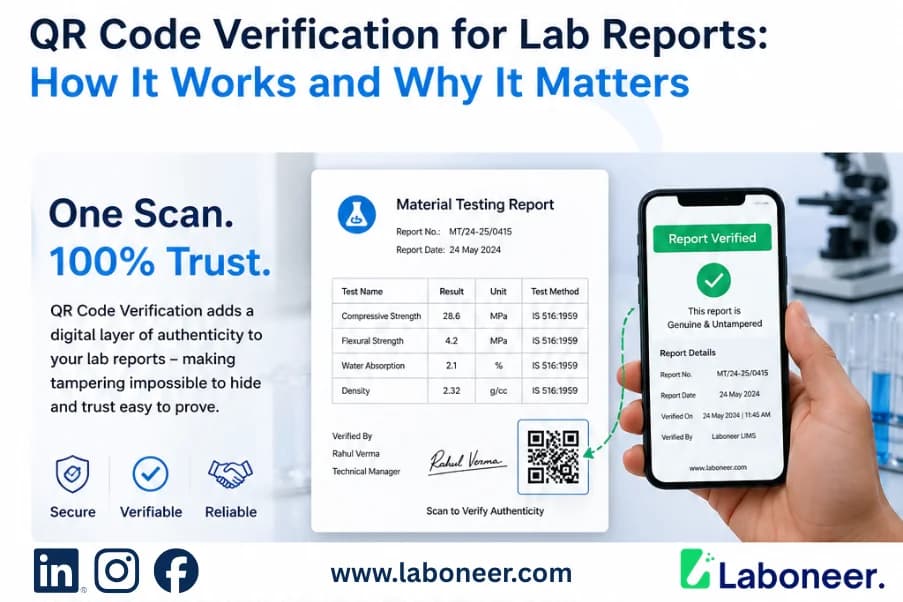
What is QR Code Verification for Lab Reports?
It’s a system where:
-
Every report has a unique QR code
-
Scanning it opens a live verification page
-
That page shows the original report data from your system
So instead of trusting a printed report…
👉 You trust the source of truth.
How QR Code Verification actually works
Let’s break it down:
Step 1: Report is generated in LIMS
-
Data is recorded
-
Report is finalized
-
(Ideally digitally signed)
Step 2: Unique QR code is generated
-
Linked to that specific report
-
Not reusable
-
Not guessable
Step 3: QR code is printed on report
-
Becomes part of the document
-
Visible to anyone
Step 4: User scans QR code
-
Opens verification page
-
Fetches data from your system
Step 5: System shows verification status
-
✅ Valid report
-
❌ Data mismatch
-
⚠️ Not found
That’s it.
Simple for users.
Powerful for your lab.
But here’s the truth most people won’t tell you
QR codes don’t prevent tampering.
They expose it.
And that’s exactly what you need.
Why QR Code Verification matters
1. Makes tampering visible
If someone edits your report:
-
Printed values ≠ system data
-
Instantly detectable
If you haven’t read this yet:
👉 Material Testing Lab Report Tampering — this is the exact problem most labs are facing today.
2. Builds instant trust
Clients, auditors, and authorities can:
-
Scan
-
Verify
-
Trust
No back-and-forth.
No emails.
3. Protects your reputation
When a fake report appears, you can say:
-
“Scan the QR code”
-
“Check the system”
Truth becomes obvious.
4. Reduces revenue leakage 💸
This is the hidden benefit.
Every time someone:
-
Reuses an old report
-
Edits instead of testing again
👉 You lose money.
QR verification discourages reuse.
If you want to go deeper:
👉 How Material Testing Labs Lose Revenue Due to Report Reuse
5. Keeps you audit-ready
For standards aligned with National Accreditation Board for Testing and Calibration Laboratories:
-
Traceability matters
-
Authenticity matters
QR verification helps you prove both.
Where most labs get it wrong
They add a QR code…
But:
-
It links to a static PDF
-
Or just a report number
-
Or worse—nothing meaningful
That’s not verification.
That’s decoration.
What a proper QR verification system should do
When scanned, it must:
-
Show original report data
-
Display verification status
-
Highlight mismatches
-
Work in real-time
Anything less?
👉 Not reliable.
QR Code vs Digital Signature (Important)
Let’s be clear:
-
QR Code → makes verification easy
-
Digital Signature → makes tampering detectable
You need both.
If you haven’t explored this:
👉 Digital Signature in Lab Reports: The Only Way to Make Your Reports Tamper-Proof
One simple addition that changes everything
Add this line on your report:
“Scan QR code to verify authenticity. Only system-verified reports are valid.”
Now:
-
User is guided
-
Responsibility is shifted
-
Your lab is protected
Final truth (read this carefully)
You cannot stop people from trying to manipulate reports.
But you can make sure:
👉 They cannot prove it came from you.
If you’re running a lab, ask yourself:
-
Can someone verify your report in seconds?
-
Can you prove authenticity instantly?
-
Are you losing revenue due to report reuse?
-
Do you have a system beyond PDFs?
If not…
You don’t have control over your reports.
The shift smart labs are making
They are moving from:
-
“Generating reports”
To:
-
“Verifying reports”
-
“Protecting revenue”
-
“Building trust”
Because today:
👉 Trust is not given.
👉 It is verified.
And one simple QR code…
Can make that possible.